A coalition of Portland neighborhood associations and transportation advocacy groups are sounding the alarm about a recently-announced pavement resurfacing project on West Burnside Street.
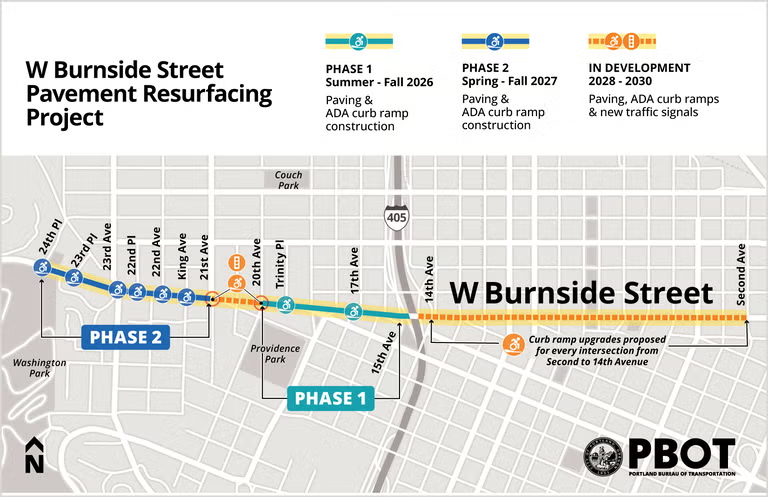
The project, which advocates spotted on the Portland Bureau of Transportation’s (PBOT) website earlier this summer, sets out to fix “failing pavement” and fix non-compliant ADA ramps along a 22-block stretch of W Burnside. Project critics say PBOT shouldn’t be taking on a major road repair project without reconfiguring Burnside’s design to better accommodate people biking, walking, and taking the bus.
Burnside Street stretches across Portland, and serves as the dividing line between the city’s north and south segments. While the street sees significant foot traffic on both sides of the river, this stretch of West Burnside is home to some of Portland’s most iconic destinations, including Powell’s Books, McMenamins Crystal Ballroom, and, yes, Voodoo Doughnut. But despite its cultural and practical significance, Burnside is one of Portland’s most dangerous streets, seeing disproportionate rates of crashes with serious or fatal injuries.
Some Portlanders see the major street repair project as an opportunity for PBOT to rethink West Burnside—beyond just smoothing the pavement. In a July 21 letter to city leaders, several transportation advocates and west side neighborhood association representatives outlined their concerns with PBOT’s current plans for W Burnside.
The letter says W Burnside is “currently not living up to its potential,” citing narrow sidewalks, fast car traffic, dangerous intersections, and a lack of transit access, but adds the city has “the chance to fix this and make Burnside the vibrant destination it should be.”
“Currently, PBOT is planning [to restripe] W Burnside using the same lane configuration that it has now, without addressing the unpleasant and dangerous conditions,” the letter states. “This is a huge missed opportunity that threatens to lock Burnside in as a High Crash Corridor for the next 20 years.”
The letter was signed by representatives from advocacy groups 1000 Friends of Oregon, Better Block PDX, BikeLoud, Families for Safe Streets, Oregon Walks, and Strong Towns PDX. Leaders from four adjacent neighborhood associations—representing Downtown, Goose Hollow, the Northwest District, and Old Town—also signed onto the statement.
In recent years, PBOT has often attempted to conserve resources by combining major pavement repair projects with other street safety improvements. PBOT added additional infrastructure elements to its repaving projects on Southeast Hawthorne Boulevard, Northeast Broadway, Southwest 4th Ave, and more. Transportation advocates have seen these repaving projects as an opportunity to encourage the city to rethink a street’s current design and fight for protected bike lanes and crossing improvements, among other goals.
Many advocates are especially concerned that PBOT announced its plans for W Burnside just a month before it intended to break ground on the project. The July 21 letter said the constrained timeline “essentially [prevents] the community from having any say in the future of this major corridor.”
Hannah Schafer, PBOT’s communications director, told the Mercury that while the bureau agrees W Burnside “has many needs beyond the pavement condition,” repairing the pavement has been a “long-standing community request.” Schafer pointed to multiple other projects PBOT has completed along W Burnside over the last few years. Since 2019, the city has added eastbound bus and bike lanes to improve access to the Burnside Bridge, among other changes further west.

But advocates have called for more changes. PBOT’s own Central City in Motion plan, adopted by City Council in 2018, calls for several transportation safety projects on W Burnside, including an extended bus priority lane that has yet to come to fruition. Others have since called for a further reimagining of the street, especially in light of the Burnside Bridge replacement project (which is currently in a state of purgatory pending the availability of federal funding).
Schafer said the existing investments on W Burnside will “benefit from smoother pavement,” and the maintenance project “will not preclude future safety or transit priority work on the corridor.”
The city has already begun work on the first phase of the W Burnside project, which is focused on the segment between 15th and 20th Avenues. The project’s first phase is expected to cost $2.4 million, not including construction of ADA ramps at two intersections.
“Design for later phases has not yet begun, and we are considering additional community input into how to best sequence and deliver the work,” Schafer said.
Advocates called on city leaders to pause the project and “allow for a community conversation that ensures that West Burnside works for everyone.” They pointed to crash data showing four traffic fatalities on W Burnside in the last decade, as well as many more injuries.
“A street this dangerous is not good for business, is not good for tourism, and is not good for encouraging people to explore our city on foot or by bike,” the letter states. “A better Burnside is possible. Please help us achieve our vision for a more livable, vibrant, and safer street and downtown Portland.”