


A few days ago I was biking along SE 41st and Hawthorne and came to a confusing situation: a stop sign, in front of a crosswalk signal showing a red hand. Since there were no cars around, could I bike across? Or did I have to wait for the pedestrian signal to change? Or did I have to stop at the stop sign and then cross?
I wound up doing what most people probably do: Looking guiltily around for cops and then darting through the intersection.
There are 48 of these half-signals around Portland (like at 41st and Glisan, 39th and Taylor, and 16th and Hawthorne) but according to the federal government, the city should tear them all out. They’re too confusing, say the feds. But half-signals like these are integral to the city’s plans to remake Portland’s streets so they’re safer and easier for pedestrians and cyclists to use.
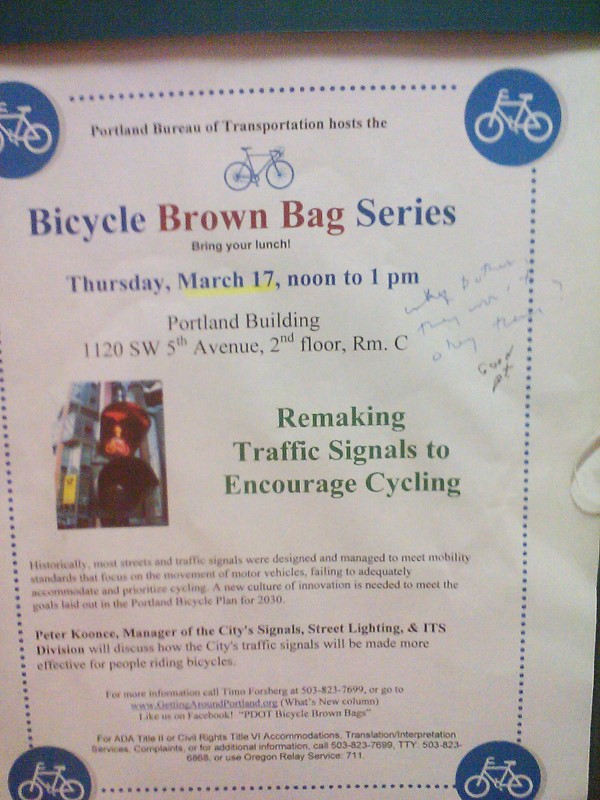
Last week, Portland Bureau of Transportation staffer Peter Koonce discussed over a brown-bag lunch session how to redesign signals to encourage biking. Koonce noted that even his own posters for the talk, taped around the Portland Building, had been heckled. Next to the title, “Remaking signals to encourage cycling” some cynical city employee had scrawled, “Why bother? They won’t obey them.”
So is it possible to actually design an intersection that will keep fewer cyclists from running the light? The city’s had some success, but sometimes by going against how the feds say streets are supposed to work.
Check out the city’s statistics on the “scramble” light just south of the Rose Quarter. This one, which gives bikes their own signal to cross an intersection on a diagonal and was built thanks to a $10,000 state grant in 2004:

- Streetfilms
Before the scramble light was put in, 66 percent of people on bikes run the light. Nowdays, only 13-19 percent run the light. Why? Because an intersection whose rules were straight up inconvenient and unhelpful for bikes—even when there’s no traffic, you’d have to wait through two pedestrian light cycles to cross the intersection in two crosswalks—was remade in a way that made sense for bikes. Success!
Another change the city can make is setting light cycles to change to green at a speed that’s good for bikes—so if you’re biking down a street, all the lights will be green for you. This “green wave” occurs on SW 4th Avenue downtown and on the new Eastside Couch couplet, but, annoyingly, not on the major bike routes of North Williams or Vancouver, where the aggro dudes speeding past people and racing through yellow lights have the best shot of an uninterrupted commute.
The most visible intersection remake recently has been at North Williams and Broadway, where a lot of car commuters turn right onto I-5 and bike commuters either head straight to downtown or turn right on Williams. It was a pretty harrowing intersection that often brought me close to my fear of being crushed to an agonizing death under the tires of an 18-wheeler. So the city created two car right-turn lanes, added a “no right turn on red” sign, added a bike-specific signal, and added a detection device at previous intersections so the bike signal is likely to flip on when cyclists approach (video and pictures here).
The result? Chaos! The statistics aren’t out yet, but while it’s potentially a safer intersection, all the signage and special signals have been super confusing. And since the fed’s only measure of effectiveness of an intersection is vehicle delay, it’s a step backward in their eyes.
As the city aims to triple the number of bike trips in Portland over the next 30 years, we’re going to see a lot more intersection remakes in the future.
Semi-related question: At the end of Williams at Killingsworth there’s a T intersection with stoplight. Only peds and bikes can go straight and before the light for cars turns green, the crosswalk light to go signals for peds. The delay is only a few seconds, but not insignificant. I usually bike through with the crosswalk signal but feel a little sheepish about it. Am I law-breaking?
Also, it doesn’t take aggro riding to hit a “green wave” in North Portland, particularly heading downhill on Vancouver Ave. It seems minor tweaks could make it possible for everyone on both Vancouver and Williams, which would be very cool.
Hmm, I thought that Koonce recently re-timed the lights on Vancouver to fit with the average speed of bikes.
I heard from a traffic signal right after the presentation that they are working on retiming Vancouver.
@TSW- Working on it. Hopefully the green wave will be easier to catch uphill after this project:
http://www.portlandonline.com/transportati…
Thanks for the relevant link, Allan.
Does anyone have an answer to TSW’s question? I never know what to do there either.
I asked bike lawyer Ray Thomas about the signal on Burnside and 20th than lets pedestrians go six seconds before cars and he said you could bike through it, but only if you were “acting as a pedestrian” by biking the crosswalk (I think that was it, anyway, I could be wrong).
@smirk @TSW: yeah, I think that early crosswalk light is for “peds” and not cyclists. Sorry that I can’t confirm this for sure. I could probably look it up… but it’s Friday!
My interpretation (though I’m too lazy to look up a citation at 3 a.m.): You’d have to be both riding in the crosswalk and riding at a walking speed to use the ped signal. Not really worth it, if you ask me. (But I’d bet your chances of getting pinched for running it are very, very low.)