


I’m working this week on a cover story about change on North Williams, particularly noting the recent uproar around the transportation project planned for the street. After a six-month delay to include more public process, the recommendations for how to make the street safer (wider bike lane? Remove a car travel lane? Install more cross walks?) are finally due this March.
When people talk about gentrification, the conversation can get vague and highly emotional. So the story this week focuses on the facts and figures of change. Here are some quick mind-boggling statistics from North Williams:
• Of the 62 retail spaces along North Williams from Broadway to Alberta, 42 have opened just since January 2007. That’s means 68 percent of businesses on the street are less than five years old.
• The entire budget of the Williams transportation project—including planning, outreach, and actual construction—is $370,000. To put that in context, the cost of one stoplight is $200,000. Of that $370,000 budget, 25 percent has already been spent on planning and public involvement.
• The racial demographics have almost completely flipped: In 1990, 70 percent of the neighborhood was black and 21 percent was white. Today, the neighborhood is 27 percent black and 54 percent white.
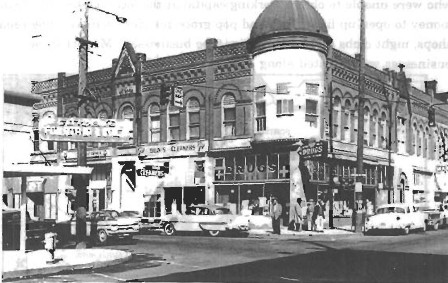
• From 1956 to 1970, three back-to-back urban renewal projects tore down over 1,500 houses in the Albina neighborhood (of which Williams is the heart). Here’s what the street looked like in 1962. In 1972, it looked like this:

One of the points of tension for long-time residents of the neighborhood is seeing those places where African-American homes and businesses used to flourish turning into vacant lots and then fancy new projects. As Urban League Advocacy Director Midge Purcell told me, “There were music venues, social clubs. All the things that made it a community, those things are no longer here and the things that have replaced them are the exact opposite of what made this community.”
Maybe someday there will be less roads, say one avenue every three or four blocks rather than every single block. This would make neighborhoods more community dense and foot traffic friendly. Roads are an inefficient use of land.
The “exact opposite” – sounds really hyperbolic to me. I sympathize with the loss of the cultural enclave, but the businesses that are moving in are similar to the businesses that used to exist, its just that they do not cater exclusively to African American customers. They also do not exclude them, so it’s really up to the African American community to reclaim their community and be a part of the renaissance, either as customers of the new businesses, or as entrepreneurs with and expanded vision of who their customers are.
Is Sarah Mirk trying to win nice white kid merit badge?
I sit here in stunned silence every time I read something by this supposedly-educated journalist who seems to think that all black people are poor and helpless. I don’t think that she is a racist or anything, I am just shocked that she seems to lack any understanding of economics. Kimbo Slice can move to the Pearl District and Newt Gingrich can move to N Williams. It is all about money and doesn’t have one thing to do with race.
I saw something interesting today: Eliot (the neighborhood which is mostly east of Williams) & south of Fremont is 50-75% renter occupied. Almost none of the blocks is even 50% owner-occupied.
Urban renewal has a long sordid history of screwing minorities and the poor. I’m pretty sure more than a project or two has been cited on the basis of those in power not giving two shits about the people living there.
While economics are definitely a factor of who lives and continues to live in this area, you cannot talk about this neighborhood without including the racial component. That’s just a fact and to ignore it does more harm than good.
That said, I don’t believe it has to be discussed in a negative way, especially considering the reason why so many black folks were placed in this neighborhood in the first place.
http://www.ccrh.org/center/posters/nepassa…
This is where the naive ideals of many bikers come to a clash. Funny stuff.
Yeah, god forbid African-Americans move to the suburbs like white people. Ugh. When I lived in Vancouver, I lived in a new subdivision where my 1600 square foot house was the smallest in the development. Most were over 2000 square feet and two-level. They were nice houses with nice yards and nice neighbors. Kids would leave their bikes in front of their house and they’d be there the next day. More than few times, we accidentally left our garage door open overnight. Nothing ever got stolen.
On just my short little block of the subdivision, we had two African-American families, a family immediately next door with kids, and an older woman just across from us. (The mullet man with a ’70s corvette and wife who always wore Daisy Dukes in the summer who lived next to her would mow her lawn every week.) This is a large part of why only 25% of North Portland is African-American and I say good for them. I don’t know why people think that self-segregation is a good thing. My other next door neighbor was a mixed-race couple, an Asian and white. There were many other Asians, blacks, and hispanics in the neighborhood, along with recent immigrants from Eastern Europe. It may be presumptuous, but I think that neighborhood was what civil rights activists were largely fighting for.
The 1962 photo is the corner of Williams and Russell, looking north through the intersection. I’m wondering what section, exactly, of Williams the 1972 photo is of; it appears to be further up the street, is this right?