October’s second-run screenings are always full of familiar slashers, but there’s more than a few moody, beautiful gems cast amongst the gore. Plucked from our repertory roster, we’d like to draw your attention to an easily-overlooked eco-fable of a dragon god in an angry pond and Robert Eggers’ obsession with period accuracy. Our what-to-watch suggestions this month roam toward the weird; Masahiro Shinoda’s visual excess, Puritan psychological dread, and the single best almost-silent vampire film show up. But perhaps the scariest foundation for a horror film is also the most mundane: David Cronenberg got divorced once, and he was pissed off about it. Different routes into the dark unfold below. Pick your poison, light your lantern. You will no doubt find yourself somewhere unsettling.
Faust on 16mm
For fans of Benjamin Christensen’s Häxan (1929), Mikhail Bulgakov’s The Master and Margarita (1967), bargain hunting.
F.W. Murnau’s Faust (1926) came to define German Expressionist cinema. The director’s aesthetic decisions—painterly chiaroscuro, winged angels and cowering demons, slivers of light, gold and agony—reveal his persistence of vision, transforming Faust from moralistic cautionary tale into fascinating artwork.
You probably already know the story: Loosely adapted from Goethe’s 1790 tragedy, Faust follows a gentle, bearded alchemist (Gösta Ekman) whose village has been ravaged by plague. When Mephisto (Emil Jannings) offers him youth and passion in exchange for his soul, Faust accepts out of desperation—which wreaks havoc on his life and the person he loves.
Murnau’s cosmology flickers between fiery hellscapes and freezing extremities, where Gretchen (Camilla Horn), the film’s spectral, shivering, Virgin Mary-esque character, finally meets her fate.
It’s a lot to take in, and it’s worth it. Seattle soundscapers Accendino will live score this 16mm screening; their “garage jazz” approach blends prog rock, doom, funk, and ambient elements. Sure, why not? (Clinton Street Theater, 2522 SE Clinton, Sun Oct 11, 7 pm, $15 cstpdx.com, not rated)
Demon Pond
For fans of Nobuhiko Obayashi’s House (Hausu) (1977), Masaki Kobayashi’s Kwaidan (1965), Gakuryū Ishii’s August in the Water (1995).
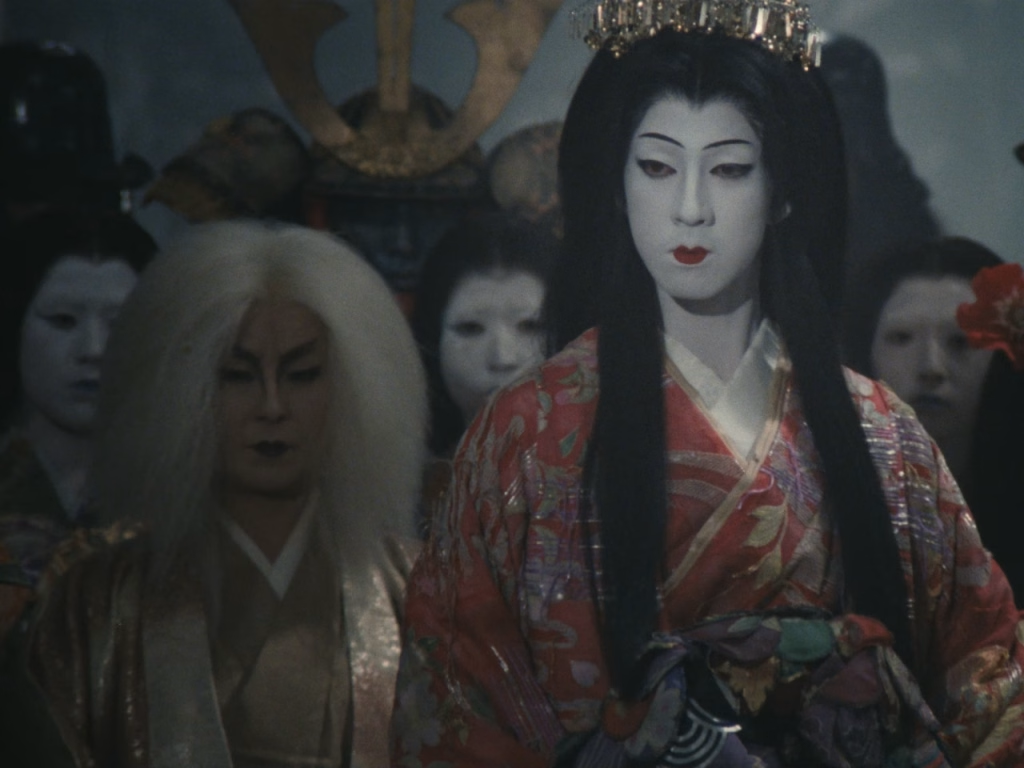
Japanese New Wave innovator Masahiro Shinoda’s 1979 film is less straight horror than creepy eco-fable. Like a murky pond, the longer you look at the film, the more you might notice that it teems with something you recognize. While Demon Pond’s fantasy ripples and splashes, saturated with haunted streams and sudden squeezes of breast milk, class anxiety, nationalism, and collective hysteria lurk beneath its surface.
Demon Pond features one of history’s least convincing wigs—a silvery, helmet-like mass plopped conspicuously on one character’s head in a confusing attempt at disguise. Beyond that, though, the film’s visuals exude prime psychedelia. Adapted from a 1913 Kabuki play, Demon Pond combines Japanese folklore with theatrical staging, and the whole thing hangs together with a distinct ’70s sensibility. Miniature sets and groovy composite shots stand out, and Isao Tomata’s squelchy Moog score sounds weird and satisfying.
Renowned Kabuki performer Tamasaburo Bando plays both Yuri—a poised, somewhat ghostly woman—and Yuki, the local dragon goddess she serves. When a wandering schoolteacher (Tsutomu Yamazaki) meets Yuri, her learns that she’s tasked with appeasing the goddess to prevent catastrophic floods. But when the events of this film take place, a drought has complicated matters.
You’ll spot notes of House’s technicolor chaos, Onibaba’s atmospheric eeriness, and even Jim Henson’s The Dark Crystal here—an extended scene of an anthropomorphized crab and carp chatting with a catfish veers toward surreal comedy. (Clinton Street Theater, 2522 SE Clinton, Thurs Oct 15, 7 pm, cstpdx.com, not rated)
Vampyr
For fans of candelabras, memento mori, Jack Clayton’s The Innocents (1961).
Allan Gray (Nicolas de Gunzburg), an occult-obsessed dreamer, finds lodging at a secluded French inn. That night, a stranger leaves a mysterious package in his room, then retreats to a nearby manor. What follows in Danish director Carl Theodor Dreyer’s Vampyr (1932) elicits terror largely through images.
A figure faces the ocean holding a scythe. Wallpaper grows hazy and begins to swirl. Shadowy figures tangle with tree branches reflected in water. A stagecoach cuts through fog. Candles flicker near a trap door. Gray’s face registers confusion and horror as the world he knew seems to dissolve.
Dreyer uses silent film techniques—title cards in gothic script do much of the storytelling—which make the film’s few lines of dialogue land with impact. Shot through a scrim of gauze, Vampyr feels labyrinthine and deliberately disorienting, like sleepwalking through a soft-focus ghost world.
Loosely referencing Sheridan Le Fanu’s In a Glass Darkly (1872)—particularly his femme vampire story Carmilla—Vampyr was funded by Baron de Gunzburg, who bankrolled the project in exchange for its starring role. It also features the fairy-like Léone (Sybille Schmitz), whose possessed gaze mirrors Isabelle Adjani and Lily-Rose Depp’s performances in the 1979 and 2024 Nosferatu films, respectively.
This screening will be live scored by Philly-based artist-producer Kraftwitch. Vampyr ends with a surprisingly gruesome and original death; how will Kraftwitch interpret it through sound? (Tomorrow Theater, 3530 SE Division, Fri Oct 30, 7 pm, $15, tomorrowtheater.org, not rated)
Also worth it:
The Haunting (1963)
Based on Shirley Jackson’s The Haunting of Hill House, Robert Wise’s psychological horror classic makes the novel’s unreliable narrator feel especially potent and frenzied on screen. (Cinema 21, Oct 10, cinema21.com)
The Brood
David Cronenberg’s 1979 film preserves his signature body horror, but gets surprisingly personal. A horde of murderous, parthenogenetically born, psychic rage-children emerge from the director’s mid-divorce anguish. (Hollywood Theatre, Oct 18, hollywoodtheatre.org)
The Witch
Robert Eggers’ folklore-with-precision style was already fully visible in his first major feature, which permeates a dreary Puritan farm with supernatural dread and suspicion, plus period-accurate roof-thatching techniques. (Tomorrow Theater, Oct 22, tomorrowtheater.org)
When Evil Lurks
This Argentinian horror is mean and relentless, with a particular interest in finding new, disturbing ways for a demonic invasion to go very wrong. The real freaks (fans of New French Extremity or The Sadness) can stomach it. (Cinemagic, Oct 27-28, thecinemagictheater.com)
House (Hausu)
Nobuhiko Obayashi’s most famous film blends kitsch and teeny-bopper hyperbole with playfully unpolished green screen. Heads roll, pianos turn carnivorous, and Blanche, a gargantuan house cat, yowls in discontent. (Tomorrow Theater, Oct 31, tomorrowtheater.org)